
Scarless Lower Blepharoplasty Before & After in Beverly Hills
Transconjunctival Lower Eyelid Surgery for Under-Eye Bags | Elie Ramly, MD
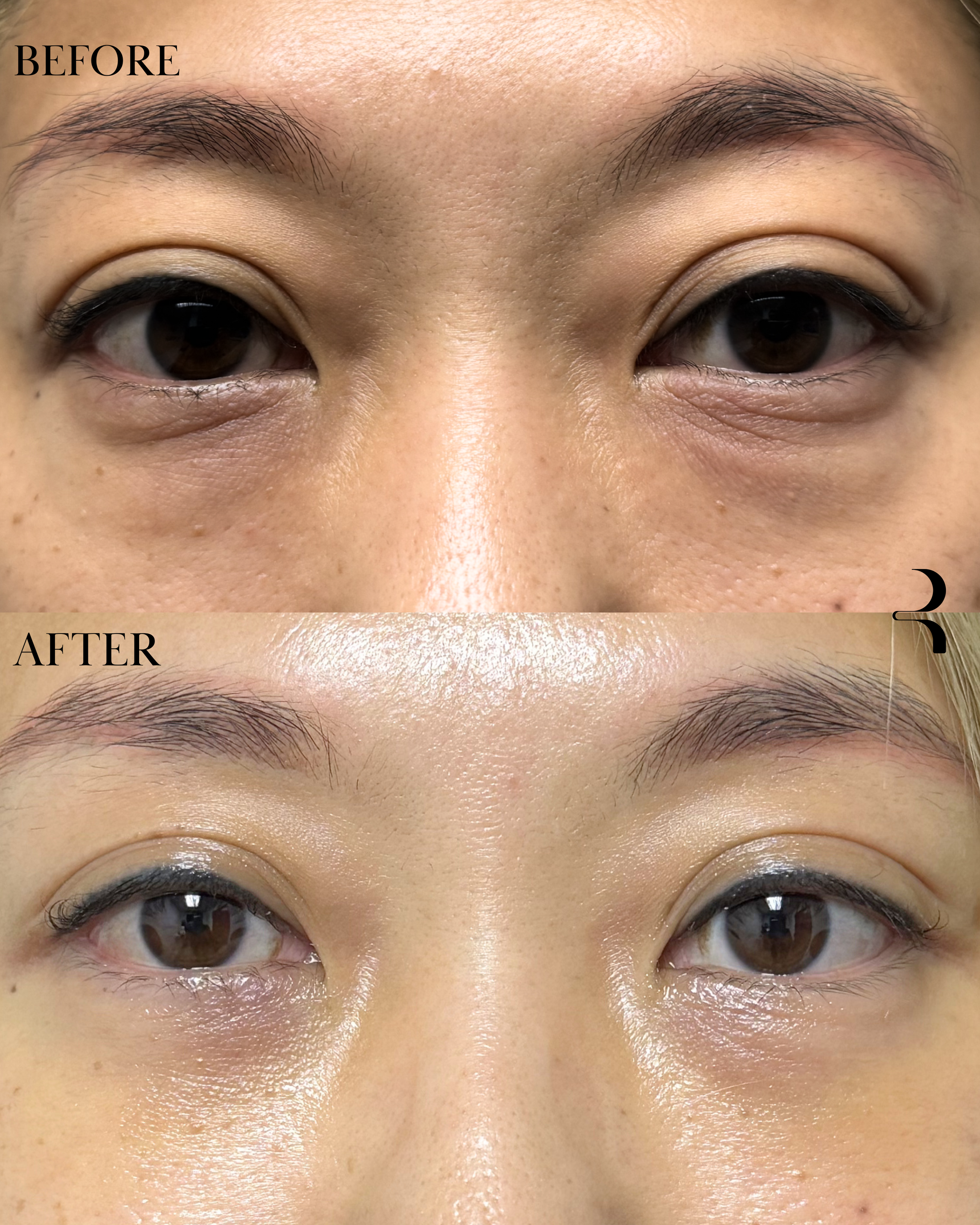
Before and after transconjunctival lower blepharoplasty, commonly called “scarless” lower blepharoplasty, performed by Beverly Hills plastic surgeon Dr. Elie Ramly.
Natural Under-Eye Rejuvenation Without an External Skin Incision
This patient underwent transconjunctival lower blepharoplasty, commonly called scarless lower blepharoplasty, performed by Beverly Hills plastic surgeon Dr. Elie Ramly.
The procedure was designed to address prominent lower eyelid bags and improve the transition between the lower eyelids and cheeks while preserving the patient's natural eye shape and facial identity.
Unlike traditional external-incision lower blepharoplasty, the transconjunctival approach accesses the lower eyelid fat compartments through an incision inside the lower eyelid, leaving no external skin incision.
The before-and-after photographs demonstrate a reduction in the appearance of under-eye bags and a smoother lower eyelid contour, creating a more rested appearance without fundamentally changing the patient's eyes.
Case Overview
Procedure: Transconjunctival Lower Blepharoplasty
Also Known As: Scarless Lower Blepharoplasty, Lower Eyelid Bag Removal, Lower Eyelid Fat Repositioning (when performed)
Surgical Approach: Internal lower eyelid incision through the conjunctiva
Surgeon: Elie Ramly, MD
Location: Beverly Hills, California
Primary Goals: Reduce under-eye puffiness, improve lower eyelid contour, and preserve natural eye shape
Before and After: What Changed?
1. Reduction of Under-Eye Bags
The preoperative photograph demonstrates fullness beneath both lower eyelids, creating visible under-eye bags and a more pronounced transition between the eyelids and cheeks.
The postoperative photograph shows a smoother under-eye contour, with reduced prominence of the lower eyelid bags.
2. Smoother Lower Eyelid–Cheek Transition
A youthful lower eyelid typically has a relatively smooth transition into the upper cheek.
With age or inherited anatomy, protrusion of the lower eyelid fat compartments can create a bulging appearance, sometimes accompanied by a shadow or groove beneath the bags.
Transconjunctival lower blepharoplasty allows the surgeon to address these fat compartments directly, using techniques tailored to the patient's anatomy.
In this case, the visible result demonstrates improved continuity between the lower eyelids and upper cheeks.
3. Preservation of Natural Eye Shape
One of the most important objectives of lower eyelid surgery is to improve the appearance of the under-eye area without altering the patient's natural eye shape.
The postoperative photograph demonstrates preservation of the patient's recognizable eye contours while reducing the prominence of the under-eye bags.
What Is Scarless Lower Blepharoplasty?
Scarless lower blepharoplasty is a commonly used term for transconjunctival lower blepharoplasty, a surgical approach that accesses the lower eyelid fat through the inner surface of the eyelid.
Because the incision is placed internally, there is no external skin incision or visible external incision scar from this approach.
The procedure may involve selective fat removal, fat repositioning, or a combination of techniques, depending on the patient's anatomy.
Importantly, “scarless” does not mean that no incision is made or that no internal scar tissue forms. It refers specifically to the absence of an external skin incision.
Who Is a Good Candidate for Transconjunctival Lower Blepharoplasty?
This technique may be particularly appropriate for patients who have:
Prominent under-eye bags caused by protruding lower eyelid fat
Relatively good lower eyelid skin elasticity
Limited excess lower eyelid skin
A desire to improve under-eye contours without an external skin incision
Appropriate lower eyelid support and anatomy
Patients with significant skin laxity, eyelid malposition, or other anatomical concerns may benefit from additional or alternative procedures.
The choice of surgical approach should be individualized rather than determined by a preference for avoiding an external incision alone.
Transconjunctival vs. Traditional Lower Blepharoplasty
There are two principal surgical approaches to the lower eyelid.
Transconjunctival lower blepharoplasty uses an incision inside the lower eyelid, allowing access to the fat compartments without an external skin incision.
Transcutaneous lower blepharoplasty uses an incision just beneath the eyelashes, providing access to lower eyelid tissues and facilitating direct skin management when appropriate.
Neither approach is universally superior.
The choice depends on the patient's anatomy, degree of skin excess, fat distribution, eyelid support, and aesthetic goals.
The Ramly Method: Natural Results Through Anatomical Precision
Dr. Ramly approaches lower eyelid rejuvenation by carefully distinguishing between the anatomical causes of under-eye concerns.
Not all under-eye fullness, hollowness, dark circles, or skin changes require the same treatment.
For some patients, the primary issue is protruding lower eyelid fat. Others may have volume deficiency, skin laxity, pigmentation, or a combination of these factors.
The surgical plan is tailored to the specific anatomical problem rather than applying the same procedure to every patient.
The objective is to create a smoother, more rested appearance while preserving natural eyelid position, eye shape, and facial expression.
Frequently Asked Questions
Is scarless lower blepharoplasty really scarless?
The transconjunctival approach uses an incision inside the lower eyelid, so there is no external skin incision. Internal healing and scar formation still occur.
Can lower blepharoplasty remove under-eye bags?
Yes. When under-eye bags are caused by protruding orbital fat, lower blepharoplasty can reduce their appearance through selective fat removal, repositioning, or other individualized techniques.
Will lower blepharoplasty change my eye shape?
Preserving natural eye shape is a central surgical goal. However, lower eyelid surgery carries risks, including changes in eyelid position or contour, and outcomes cannot be guaranteed.
Does transconjunctival lower blepharoplasty tighten loose skin?
The internal approach primarily provides access to lower eyelid fat. It does not directly remove excess external skin. Additional treatments may be considered when skin laxity is present.
Is scarless lower blepharoplasty suitable for younger patients?
Yes. Under-eye bags may be hereditary and can occur in younger adults. Suitability depends on anatomy rather than age alone.
How long does recovery take after transconjunctival lower blepharoplasty?
Swelling and bruising often improve substantially over the first one to two weeks, although healing varies and residual swelling may persist longer. Final refinement develops over subsequent weeks to months.
Are the results of lower blepharoplasty permanent?
Surgical correction of protruding lower eyelid fat can provide long-lasting improvement, but natural aging continues, and changes in skin quality or surrounding facial volume may develop over time.
Scarless Lower Blepharoplasty Consultation in Beverly Hills
Dr. Elie Ramly offers individualized lower eyelid rejuvenation consultations in Beverly Hills, including transconjunctival lower blepharoplasty, traditional lower blepharoplasty, and complementary procedures when appropriate.
His approach emphasizes anatomical precision, natural-looking results, preservation of eye shape, and thoughtful surgical planning.
Elie Ramly, MD
Plastic Surgeon
Ramly Plastic Surgery
Beverly Hills, California