
Revision Rhinoplasty With Donor Rib Cartilage Grafting Before & After in Beverly Hills
Structural Revision Rhinoplasty, Nasal Tip Deprojection and Donor Rib Cartilage Reconstruction | Elie Ramly, MD
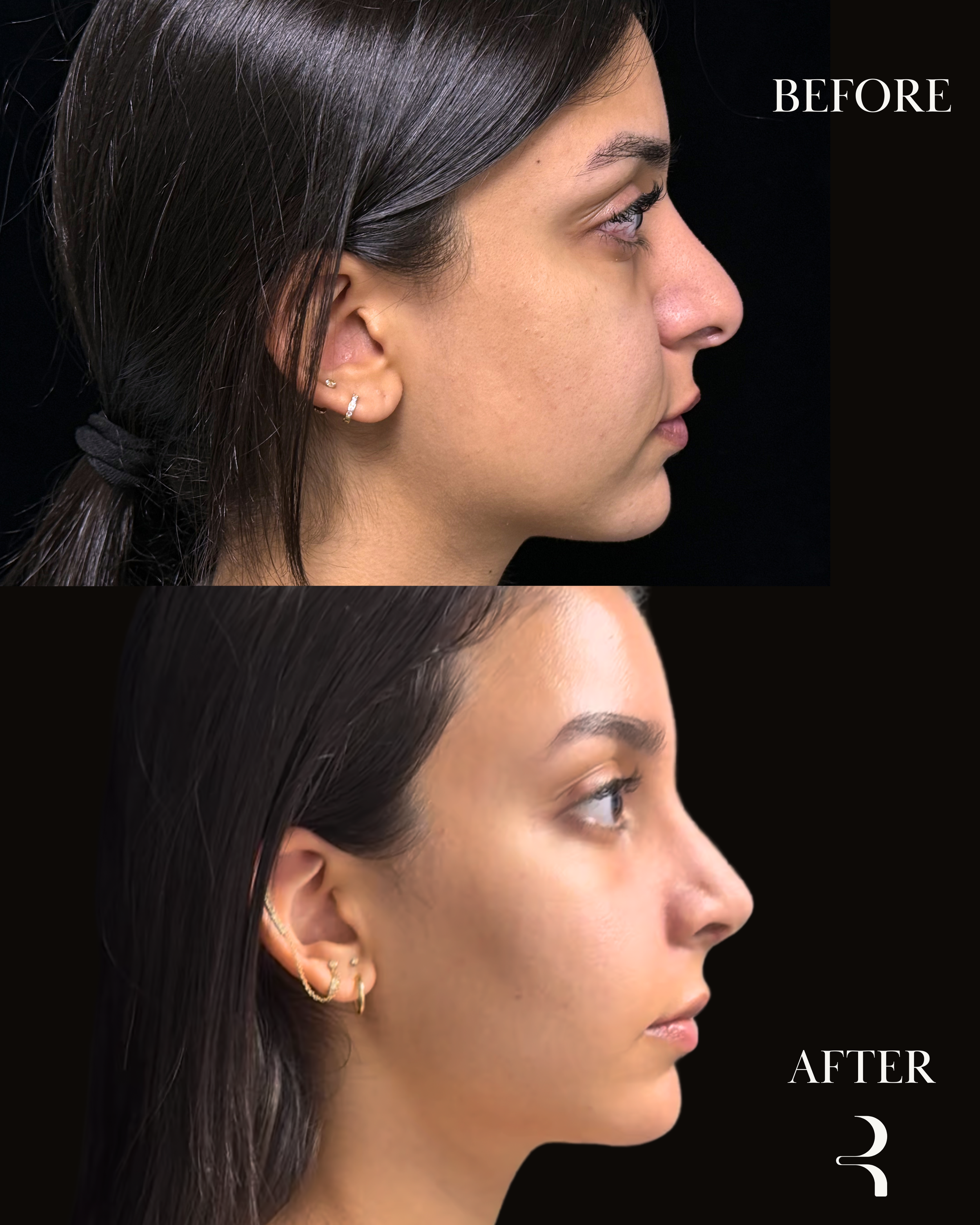
Before and after revision rhinoplasty with donor rib cartilage grafting and nasal tip deprojection, performed by Beverly Hills plastic surgeon Dr. Elie Ramly.
Revision Rhinoplasty: Restoring Structure While Refining Nasal Proportions
This patient underwent revision rhinoplasty with donor rib cartilage grafting and nasal tip deprojection, performed by Beverly Hills plastic surgeon Dr. Elie Ramly.
Revision rhinoplasty is among the more technically demanding procedures in facial aesthetic surgery because the surgeon must work with anatomy that has already been altered by previous surgery. Scar tissue, changes in structural support, and limited availability of native cartilage can make surgical planning and execution more complex.
In this case, the surgical plan incorporated donor rib cartilage to provide structural grafting material while refining nasal tip projection and overall nasal proportions.
The goal was not simply to make the nose smaller, but to create a more balanced relationship between the nasal bridge, tip, and surrounding facial features while maintaining appropriate structural support.
Procedures Performed
Revision Rhinoplasty (Secondary Rhinoplasty): Corrective nasal surgery following a previous rhinoplasty.
Donor Rib Cartilage Grafting: Use of donor-derived costal cartilage as structural grafting material.
Nasal Tip Deprojection: Reduction of excessive nasal tip projection to improve nasal proportions and facial profile balance.
Structural Nasal Refinement: Individualized adjustment of nasal support and contour according to the patient's existing anatomy.
Surgeon: Elie Ramly, MD
Location: Beverly Hills, California
Procedure: Revision Rhinoplasty
Grafting Material: Donor Rib Cartilage (Allograft Costal Cartilage)
Primary Goals: Nasal tip deprojection, structural support, improved profile balance, and preservation of natural facial identity.
Before and After: Understanding the Changes
The lateral before-and-after photographs demonstrate changes in nasal tip projection and the relationship between the nose and surrounding facial features.
1. Nasal Tip Deprojection
One of the principal goals of this revision rhinoplasty was to reduce excessive nasal tip projection.
Tip deprojection involves repositioning and reshaping the nasal tip to create more balanced proportions while maintaining appropriate support.
In the postoperative profile, the tip appears less projected relative to the surrounding facial structures, contributing to a more harmonious nasal silhouette.
2. Refinement of Nasal Profile
Revision rhinoplasty requires careful consideration of the relationship between the nasal dorsum, tip, columella, and upper lip.
The postoperative photograph demonstrates a refined nasal profile, with changes designed to complement the patient's natural facial proportions rather than impose a standardized nasal shape.
3. Structural Support Using Donor Rib Cartilage
In revision rhinoplasty, previously altered or depleted native cartilage may limit the availability of material for reconstruction.
Donor rib cartilage provides an additional grafting option when structural support is needed.
In this case, donor rib cartilage was incorporated into the revision procedure to support the planned structural changes.
Importantly, structural reconstruction and aesthetic refinement must be considered together. Reducing projection without maintaining adequate support can compromise nasal stability or function.
Why Use Donor Rib Cartilage in Revision Rhinoplasty?
Cartilage grafting is frequently an important component of complex revision rhinoplasty.
After previous nasal surgery, septal cartilage may be insufficient or unavailable, and existing support structures may require reconstruction.
Potential cartilage sources include the nasal septum, ear, the patient's own rib, or appropriately processed donor rib cartilage.
Donor rib cartilage, also called allograft costal cartilage, can provide structural grafting material without requiring cartilage harvest from the patient's own chest.
Potential advantages include avoiding a separate rib-harvest incision and the associated donor-site discomfort.
However, donor cartilage is not automatically the best option for every patient. Graft selection depends on the reconstructive requirements, material characteristics, patient preferences, and clinical considerations.
Potential graft-related complications include infection, warping, resorption, displacement, or contour irregularities.
The choice of graft material should be individualized rather than based on a single universal preference.
Nasal Tip Deprojection: Why Less Projection Requires More Planning
Nasal tip deprojection may appear straightforward from an aesthetic perspective, but it can be technically demanding, particularly in revision surgery.
The nasal tip is supported by a complex arrangement of cartilage, ligaments, and surrounding soft tissues.
Changing tip projection can influence rotation, nostril shape, columellar position, and nasal airway support.
For this reason, deprojection must be planned in the context of the entire nasal framework.
The objective is not simply to move the nasal tip backward, but to achieve a balanced and structurally stable result that complements the patient's facial anatomy.
The Ramly Method: Structural Precision and Preservation of Facial Identity
Dr. Ramly's approach to revision rhinoplasty centers on understanding the patient's existing anatomy, the changes created by previous surgery, and the relationship between nasal structure, function, and facial aesthetics.
Rather than pursuing a predetermined nasal shape, he develops a surgical plan around the patient's individual features, goals, and reconstructive needs.
His philosophy emphasizes:
Structural preservation and reconstruction: Maintaining or restoring appropriate nasal support while refining shape.
Individualized graft selection: Choosing cartilage sources and grafting techniques according to the specific anatomical requirements.
Natural facial harmony: Refining nasal proportions without erasing the characteristics that make a patient's face unique.
Functional considerations: Accounting for nasal breathing and airway support during aesthetic reconstruction.
Long-term stability: Planning structural changes with consideration for healing, scar formation, and tissue behavior over time.
Revision rhinoplasty requires a particularly thoughtful balance between what can be changed, what should be preserved, and what must be reconstructed.
Frequently Asked Questions
What is revision rhinoplasty?
Revision rhinoplasty, also called secondary rhinoplasty, is nasal surgery performed after a previous rhinoplasty to address persistent or new aesthetic concerns, structural problems, or breathing difficulties.
Why is revision rhinoplasty more complicated than primary rhinoplasty?
Previous surgery can alter normal anatomy, produce scar tissue, reduce available cartilage, and affect nasal support. These factors may make dissection, reconstruction, and outcome predictability more challenging.
What is donor rib cartilage in rhinoplasty?
Donor rib cartilage is costal cartilage obtained from a human tissue donor and processed for surgical grafting. It can be used as structural material in selected rhinoplasty procedures.
Is donor rib cartilage the same as cadaveric rib cartilage?
Yes. The terms are commonly used interchangeably. Donor rib cartilage is generally the more patient-friendly term, while cadaveric rib cartilage and allograft costal cartilage are additional terms patients may encounter when researching revision rhinoplasty.
Does donor rib cartilage require an incision on my chest?
No. Because the cartilage is obtained from a donor, it does not require harvesting cartilage from the patient's own rib.
Can revision rhinoplasty reduce nasal tip projection?
Yes. Nasal tip deprojection can be performed during revision rhinoplasty when appropriate. The surgical plan must account for existing cartilage support, scar tissue, tip rotation, and the overall nasal framework.
Is donor rib cartilage better than using my own rib?
Neither is universally superior. Both autologous and donor costal cartilage have advantages and limitations. The choice depends on the reconstructive needs, graft characteristics, and individual patient factors.
How long does revision rhinoplasty take to heal?
Initial swelling generally improves over the first several weeks, but nasal refinement can continue for 12–18 months or longer, particularly in revision cases or patients with thicker skin.
Revision Rhinoplasty Consultation in Beverly Hills
Patients considering revision rhinoplasty benefit from a detailed evaluation of their nasal anatomy, previous surgical changes, functional concerns, and aesthetic goals.
Dr. Elie Ramly offers individualized revision rhinoplasty consultations in Beverly Hills, with an emphasis on structural reconstruction, natural facial harmony, and thoughtful surgical planning.
Elie Ramly, MD
Plastic Surgeon
Ramly Plastic Surgery
Beverly Hills, California