
Male awake Facelift and Deep Neck Lift Before and After in Beverly Hills
Awake Male Facial Rejuvenation Under Local Tumescent Anesthesia | Dr. Elie Ramly
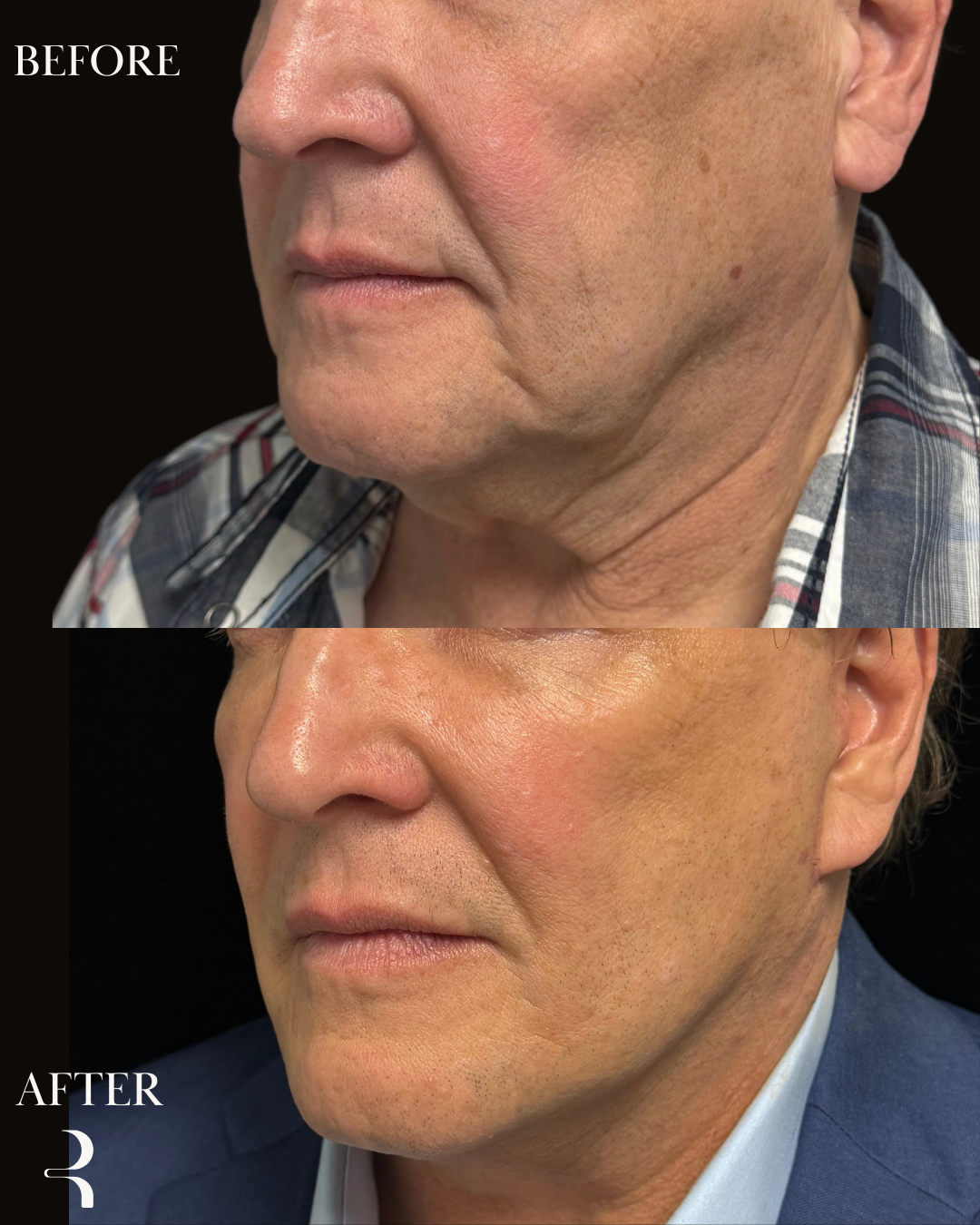
Before and after customized facelift and deep neck lift performed awake under local tumescent anesthesia by Beverly Hills plastic surgeon Elie Ramly, MD.
Case Overview
This male patient underwent a customized facelift and deep neck lift performed awake under local tumescent anesthesia by Beverly Hills plastic surgeon Elie Ramly, MD.
The surgical approach was designed to address facial and neck laxity, restore definition along the jawline, and improve the transition between the chin and neck while preserving the patient's recognizable facial features and natural masculine appearance.
Rather than applying a single facelift technique to every patient, Dr. Ramly tailors the surgical approach to the individual's anatomy, degree of facial aging, aesthetic goals, and medical considerations.
This case also illustrates an important distinction: a facelift does not always require general anesthesia. In appropriately selected patients, certain facial rejuvenation procedures can be performed awake using local anesthesia, depending on the planned surgery, patient preferences, and clinical circumstances.
Procedures Performed
Male SMAS Facelift: Surgical repositioning and support of the superficial musculoaponeurotic system (SMAS) to address lower facial laxity and improve jawline contour.
Deep Neck Lift: Surgical treatment of deeper neck structures to improve cervical contour and the definition of the chin-to-neck transition.
Awake Surgery Under Local Tumescent Anesthesia: The procedures were performed with the patient awake, using local tumescent anesthesia rather than general anesthesia.
Surgeon: Elie Ramly, MD
Location: Beverly Hills, California
Procedures: SMAS Facelift and Deep Neck Lift
Anesthesia: Local Tumescent Anesthesia (Awake)
Primary Goals: Natural masculine facial rejuvenation, improved jawline definition, and a more refined neck contour
Before and After: What Changed?
1. Improved Jawline Definition and Lower Facial Contour
In the preoperative photographs, laxity of the lower facial tissues contributes to reduced definition along the jawline and a less distinct transition between the lower face and neck.
The postoperative photographs demonstrate a more clearly defined mandibular border, with improved lower facial contour and a smoother transition toward the neck.
An important objective of male facelift surgery is to restore definition without creating an excessively tightened, pulled, or artificially sculpted appearance.
In this case, the visible changes preserve the patient's recognizable facial features while improving the structural contours of the lower face.
2. Deep Neck Rejuvenation and Cervicomental Contour
The lateral photographs particularly illustrate the importance of addressing the neck as part of comprehensive male facial rejuvenation.
Before surgery, the patient demonstrates submental fullness, neck laxity, and reduced definition between the chin and neck.
Following surgery, the photographs show:
Improved definition beneath the chin
A more distinct transition between the jawline and neck
Reduced appearance of submental fullness
Smoother neck contours
Improved overall lower facial and cervical balance
The deep neck lift was incorporated into the surgical plan to address anatomical contributors to neck contour that may not be adequately corrected by skin tightening alone.
3. Natural-Looking Male Facial Rejuvenation
The frontal and three-quarter photographs demonstrate how relatively subtle changes in lower facial support and neck contour can influence the overall appearance of the face.
The goal was not to fundamentally change the patient's features or create an exaggerated jawline. Instead, the procedures were designed to restore definition while preserving the individuality of his facial anatomy.
This distinction is central to Dr. Ramly's philosophy of facial rejuvenation: the objective is not to make every face look alike, but to help each patient look like a refreshed version of themselves.
Why Combine a SMAS Facelift With a Deep Neck Lift?
Facial aging involves multiple anatomical layers, including the skin, superficial and deep soft tissues, fat compartments, and underlying muscular structures.
In the lower face, age-related tissue descent can contribute to jowling and loss of jawline definition.
In the neck, visible contour changes may involve skin laxity, subcutaneous fat, platysma muscle changes, and deeper anatomical structures.
These changes often coexist but do not necessarily respond to the same surgical maneuvers.
A SMAS facelift addresses components of lower facial tissue descent through surgical manipulation and support of the SMAS layer.
A deep neck lift allows selected deeper structures contributing to cervical fullness or reduced neck definition to be addressed when clinically indicated.
Combining these procedures can help create a more harmonious transition between the face, jawline, and neck.
Importantly, the precise surgical maneuvers are individualized. Not every patient requires the same degree of SMAS dissection, neck muscle treatment, fat removal, or deep structural modification.
Can a Male Facelift and Deep Neck Lift Be Performed Awake?
Yes. In appropriately selected patients, a male facelift and deep neck lift may be performed while the patient remains awake under local anesthesia.
In this case, Dr. Ramly performed both procedures using local tumescent anesthesia, without general anesthesia.
Tumescent anesthesia involves carefully infiltrating a dilute local anesthetic solution into the planned surgical areas to provide regional pain control and facilitate tissue dissection.
Depending on the formulation and clinical circumstances, the solution may also contain medications intended to reduce bleeding.
Potential advantages of an awake approach in selected patients include avoiding general anesthesia and its associated recovery effects.
However, awake facelift surgery is not necessarily preferable for every patient.
The appropriateness of local anesthesia depends on the extent and complexity of the procedure, individual anatomy, medical history, patient comfort, and the surgeon's assessment of safety.
General anesthesia or other anesthetic approaches may be more appropriate in other circumstances.
The priority is not to perform every facelift awake. It is to select the safest and most appropriate surgical and anesthetic approach for each individual patient.
SMAS Facelift vs. Deep Plane Facelift: Why the Distinction Matters
SMAS facelift and deep plane facelift techniques are frequently discussed as though one approach must be universally superior.
In reality, facial rejuvenation surgery encompasses a spectrum of techniques, each with particular anatomical applications.
A SMAS facelift can involve several different methods of repositioning or supporting the SMAS, while deep plane techniques involve dissection and mobilization within deeper facial tissue planes.
The most appropriate approach depends on the patient's anatomy, tissue characteristics, degree of descent, previous procedures, and desired outcome.
This case demonstrates how a customized SMAS facelift, combined with a deep neck lift, can produce meaningful improvements in lower facial and neck contours without requiring a deep plane facial dissection.
For Dr. Ramly, the choice of technique is guided by the anatomical problem being treated rather than the popularity of a particular surgical label.
The Ramly Method: Individualized Anatomy, Natural Results
Dr. Ramly's approach to facial rejuvenation is built around an understanding of each patient's anatomy and the relationship between surgical technique, aesthetic balance, safety, and long-term tissue health.
Rather than viewing the facelift as a standardized operation, he considers the individual components of facial aging and selects the maneuvers most appropriate for addressing them.
In male patients, this includes particular attention to jawline definition, neck contour, beard-bearing skin, incision placement, and the preservation of recognizable facial features.
His philosophy emphasizes:
Anatomical precision: Addressing the structures responsible for visible aging rather than relying on skin tension alone.
Individualized technique selection: Using the surgical maneuvers best suited to the patient's anatomy and goals.
Natural facial identity: Preserving the features and characteristics that make each face unique.
Thoughtful anesthesia planning: Selecting an anesthetic approach appropriate to the procedure and patient.
Long-term perspective: Considering how surgical decisions interact with the patient's anatomy and ongoing aging process.
The objective is a refreshed, balanced appearance that remains authentic to the individual.
Frequently Asked Questions
Can a facelift really be performed while awake?
Yes. Certain facelift procedures can be performed under local anesthesia in appropriately selected patients. The suitability of an awake approach depends on the planned operation, patient factors, and clinical assessment.
Can a deep neck lift be performed under local anesthesia?
Yes. Selected deep neck lift procedures can be performed under local anesthesia, as demonstrated by this case. However, not every deep neck lift is suitable for an awake approach, particularly when the extent of surgery or other clinical factors favor a different anesthetic plan.
Is a SMAS facelift effective for men?
Yes. SMAS facelift techniques can be effective for appropriately selected male patients experiencing jowling, lower facial laxity, and loss of jawline definition. The exact surgical technique should be tailored to the patient's anatomy and aesthetic goals.
Is a SMAS facelift the same as a deep plane facelift?
No. SMAS facelift is a broad term encompassing different methods of manipulating the superficial musculoaponeurotic system. Deep plane facelift techniques involve a particular approach to deeper facial tissue mobilization. Both can be used in facial rejuvenation, but they are not interchangeable terms.
Will a male facelift make my face look unnatural?
The goal of a thoughtfully planned male facelift is to improve facial contour while preserving recognizable features and natural proportions. Outcomes depend on anatomy, technique, healing, and individual factors, and no particular result can be guaranteed.
Does a facelift automatically improve the neck?
Not necessarily. A facelift may improve some aspects of upper neck contour, but significant neck laxity or deeper cervical fullness may require additional neck-specific surgical maneuvers.
How long does recovery take after an awake facelift and deep neck lift?
Recovery varies with the extent of surgery and individual healing. Swelling, bruising, tightness, and temporary sensory changes can occur. Although local anesthesia may reduce some effects associated with general anesthesia, it does not eliminate the healing process associated with facelift and neck lift surgery. Final contour refinement can continue over several months.
Is an awake facelift safer than a facelift under general anesthesia?
Neither approach is universally safer for every patient. Local anesthesia avoids certain risks associated with general anesthesia but introduces its own considerations, including anesthetic dosing, patient comfort, monitoring, and the ability to safely complete the planned procedure. Anesthesia selection should be individualized.
Male Facelift and Deep Neck Lift Consultation in Beverly Hills
If you are considering a male facelift, deep neck lift, or awake facial rejuvenation procedure, a comprehensive consultation can help determine which anatomical changes are contributing to your concerns and which treatment options may be appropriate.
Dr. Elie Ramly approaches facial rejuvenation with an emphasis on surgical precision, natural-looking results, individualized planning, and preserving each patient's unique facial identity.
Elie Ramly, MD
Plastic Surgeon
Ramly Plastic Surgery
Beverly Hills, California