

Male Blepharoplasty in Beverly Hills: Upper and Lower Eyelid Rejuvenation Under Local Anesthesia
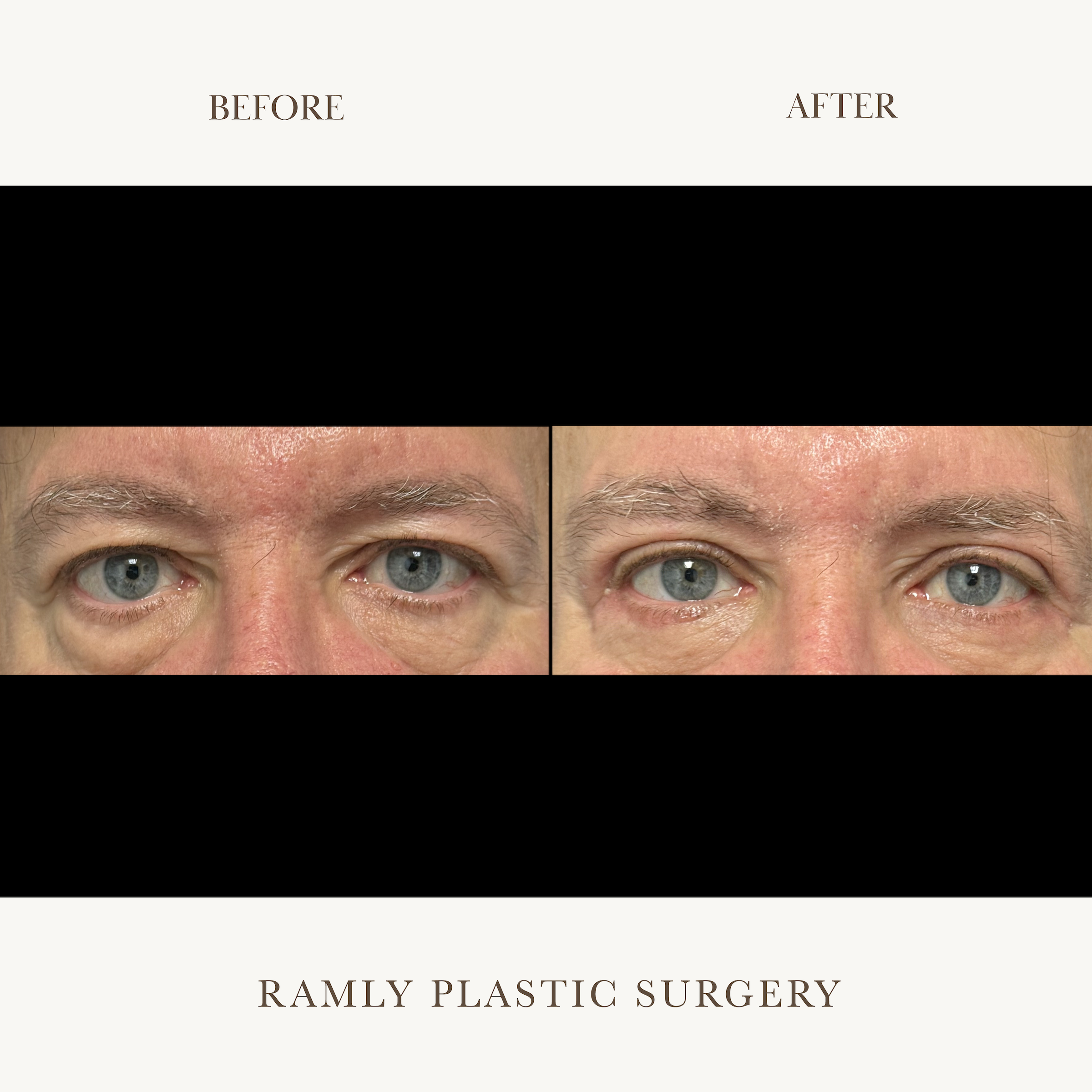
Male upper and lower blepharoplasty in Beverly Hills — 62-year-old patient before and 3 weeks after upper and lower eyelid surgery with canthopexy, performed awake in a single combined procedure under local anesthesia by Dr. Elie Ramly at Ramly Plastic Surgery. The result demonstrates identity preservation and natural aesthetic contours without any telltale signs of surgery: the eyes appear refreshed and well-rested, with preservation of masculine lid shape, crease position, and canthal tilt, and significant improvement in upper eyelid hooding, lower eyelid bags, and excess skin.
Upper and Lower Blepharoplasty Under Local Anesthesia
Male upper and lower blepharoplasty in Beverly Hills by Dr. Elie Ramly demonstrating a refined, identity-preserving approach to periorbital rejuvenation, with before and after results showing correction of upper eyelid hooding, smoothing of lower eyelid fat pseudoherniation, subtle refinement of lower eyelid skin laxity, and preservation of the patient's natural masculine eye shape and canthal position. Treatment included upper blepharoplasty, transconjunctival lower blepharoplasty with conservative fat sculpting, sub-ciliary skin "pinch" excision, and a preventive canthopexy — all performed awake under local anesthesia only, in a single combined procedure.
Natural Upper and Lower Eyelid Rejuvenation For Men
This case demonstrates a precise, identity-preserving approach to periorbital rejuvenation in a 62-year-old male patient, addressing the upper lids, lower lids, and lateral canthal support together to restore a rested, refreshed appearance while fully preserving the patient's masculine eye shape and unique character.
Periorbital aging in men typically involves a combination of upper eyelid skin hooding, lower eyelid fat pseudoherniation, and fine skin laxity of the lower lid. Achieving a natural, undetectable result requires an approach that treats the periorbital region as an integrated unit rather than addressing each component in isolation — and one that respects the anatomic rules that distinguish masculine from feminine eyes.
A selection of representative cases is shown publicly. Additional results are reviewed privately during consultation at Ramly Plastic Surgery.
Patient Goals
The patient, a 62-year-old man, sought rejuvenation of the upper and lower eyelids with correction of upper lid heaviness, smoothing of lower eyelid bags, and refinement of lower lid skin laxity. His priority was a natural, rested result that would make him look refreshed without altering the shape, character, or identity of his eyes.
A second priority was meaningful to him personally: due to his individual medical circumstances, he preferred to avoid general anesthesia. He sought a surgeon and a surgical plan that could deliver a refined, comprehensive periorbital result awake, under local anesthesia only, in a single combined procedure.
Anatomical Considerations
Examination demonstrated upper eyelid skin hooding with redundancy overhanging the tarsal platform, lower eyelid fat pseudoherniation across the medial, central, and lateral fat compartments, and fine lower lid skin laxity with early crepiness. Upper lid crease height and skin-to-brow distance were within the appropriate male range and required preservation — not elevation. The lateral canthal tendon demonstrated mild laxity without frank malposition, and the resting canthal tilt was horizontal with a subtle positive vector that was essential to preserve.
In male patients, it is essential to restore eyelid definition and smooth periorbital contour without feminizing the upper lid crease, lifting the lid aperture, rounding the eye, or hollowing the under-eye. Maintaining a low upper lid crease, a short skin-to-brow distance, a horizontal (or slightly positive) canthal tilt, and a soft — not skeletonized — lid-cheek junction is critical to preserving masculine identity.
The patient's cardiovascular and medical history were carefully evaluated and informed the decision to perform the entire combined procedure under local anesthesia only, avoiding the added systemic risk of general anesthesia or deep sedation in his specific circumstances.
Procedure Overview
Upper blepharoplasty
Transconjunctival lower blepharoplasty with conservative fat sculpting
Sub-ciliary skin "pinch" excision
Canthopexy (preventive)
Performed awake under local anesthesia, single combined procedure
Surgical Approach
A comprehensive, coordinated approach was used to address all contributing components of periorbital aging in a single operative session.
Upper blepharoplasty was designed to remove the precise amount of redundant upper lid skin needed to restore a clean tarsal platform without lifting the lid aperture, raising the lid crease, or altering the short skin-to-brow distance that defines the masculine upper lid. Skin markings were measured conservatively and confirmed in the upright position with the patient awake, allowing real-time anatomic validation that is difficult to replicate under general anesthesia.
Lower eyelid fat was addressed through a transconjunctival approach — entirely from inside the lid — across all three fat compartments, with conservative sculpting rather than simple removal to smooth the lid-cheek junction while preserving the soft under-eye contour that prevents a hollowed, skeletonized appearance. The transconjunctival approach leaves the orbicularis muscle, orbital septum, and lower lid support structures fully intact.
Because true lower lid skin excess and fine crepiness were present, a sub-ciliary skin "pinch" excision was added — a conservative removal of a measured strip of skin just below the lash line. The incision is placed within the natural lash-line shadow and heals to near-invisibility. The pinch technique addresses skin only, without violating the orbicularis muscle or deeper lower lid support.
A canthopexy was added as a preventive maneuver to reinforce the lateral canthal tendon and safeguard against any post-operative rounding, scleral show, or downward drift of the lower lid. In a well-selected male patient, prophylactic canthopexy is one of the most important safeguards against post-blepharoplasty lid malposition — and, critically, it can be executed without creating an overdone almond shape or a feminized canthal vector.
The entire combined procedure was performed awake, under local anesthesia only. Transconjunctival lower blepharoplasty and canthopexy under local anesthesia alone are considered technically demanding and require meticulous local infiltration and refined, calm execution — but in appropriately selected patients, they are safe and entirely feasible. Avoiding general anesthesia eliminated the systemic risk that would otherwise have been relevant to this patient's health profile, and supported a smoother, lighter recovery.
Care was taken throughout to preserve masculine periorbital contours and avoid overcorrection, allowing for a natural, identity-preserving result.
Learn more about upper and lower eyelid surgery: https://www.ramlyplasticsurgery.com/blepharoplasty Learn more about Dr. Ramly's approach and The Ramly Method: https://www.ramlyplasticsurgery.com/about-dr-elie-ramly
Result
The result demonstrates correction of upper eyelid hooding, smoothing of lower eyelid fat pseudoherniation, refinement of lower lid skin laxity, and full preservation of the patient's natural masculine eye shape and canthal tilt. The outcome appears rested and balanced, with no rounding of the lower lid, no scleral show, no change in lid aperture, and no visible signs of surgery.
When viewed in motion, the result maintains consistency with the patient's natural expression — his smile, squint, and animation read exactly as they did pre-operatively, without any loss of character or expressive range. This is the intended hallmark of a correctly executed periorbital rejuvenation.
Incisions heal in a manner designed to be inconspicuous. The upper lid incision is concealed within the natural supratarsal crease, and the sub-ciliary skin pinch incision sits within the lash-line shadow; both are extremely difficult to detect once healed. The result appears refined yet understated, with the patient looking like a more rested version of himself rather than surgically altered.
Early Result at Three Weeks
This case is presented at three weeks post-operatively — an early time point at which the result is already clearly established. Continued refinement is expected over the following weeks as residual subtle swelling resolves and the final contour matures. Final incision maturation takes place over three to six months.
The early clarity of the result at three weeks is itself a reflection of the combined surgical approach and the use of local anesthesia only, both of which contribute to a lighter, faster recovery. This patient was comfortable traveling and returned from a short vacation in time for his three-week follow-up.
Natural Results in Motion and Daily Life
Periorbital surgery is not evaluated in a single static photograph — it is evaluated in life. The eyes are the most expressive region of the face, and the true test of a well-executed blepharoplasty is how the eyes read during conversation, smile, squint, fatigue, downward gaze, and emotional expression.
In this case, eye shape, canthal tilt, lid crease position, and lid-cheek contour remain consistent across resting, animated, and downward-gaze positions. The patient's expressive range is fully preserved, and the result continues to read as natural across the everyday positions in which a face is actually seen — in conversation, at a dinner table, looking at a phone, or on video.
This is the standard we hold periorbital rejuvenation to: a result that is refreshed at rest and unmistakably the same person in motion.
Who This Is For
Male upper and lower blepharoplasty under local anesthesia may be appropriate for patients experiencing:
Upper eyelid hooding or heaviness with excess upper lid skin
Lower eyelid fat pseudoherniation ("bags") and a tired, shadowed under-eye
Fine lower eyelid skin laxity or crepiness
A desire to avoid general anesthesia for medical, logistical, or personal reasons
A desire for refined, identity-preserving periorbital rejuvenation that preserves masculine eye shape and character
Candidacy — and particularly candidacy for the awake, local-anesthesia version of the procedure — is determined only after a detailed in-person consultation and anatomic analysis.
When Nonsurgical Treatments Are Not Enough
When multiple components of periorbital aging are present — skin excess, fat pseudoherniation, and lid-cheek contour change — nonsurgical treatments alone cannot achieve meaningful or lasting rejuvenation, and in some cases can worsen the problem. Fillers placed into the lower eyelid or tear trough can diffuse, become chronic, distort contour, and create a puffy or uneven under-eye appearance that is more difficult to correct than the original aging pattern. Energy-based skin tightening may offer subtle benefit for fine skin laxity in isolation but cannot address true skin redundancy, fat herniation, or lid support.
In well-selected patients, a precisely designed blepharoplasty is the definitive treatment — and can be delivered with the discretion, restraint, and recovery profile that discerning patients expect.
Frequently Asked Questions
Can upper and lower blepharoplasty really be performed awake under local anesthesia only? Yes. In well-selected patients, upper blepharoplasty, transconjunctival lower blepharoplasty, skin pinch excision, and canthopexy can all be performed comfortably under local anesthesia alone. It requires meticulous local infiltration and refined surgical technique, and is not appropriate for every patient or every surgeon.
Is awake blepharoplasty safe? For appropriately selected patients, blepharoplasty under local anesthesia is very safe — and in some medical circumstances, safer than under general anesthesia, because it eliminates systemic anesthesia risk entirely. Candidacy is determined on an individual basis.
Will male blepharoplasty feminize my face? It should not. A properly designed male blepharoplasty preserves a low upper lid crease, a short skin-to-brow distance, and a horizontal canthal tilt. Feminization is a signature of over-resection and inappropriate canthal vectors — both avoidable with careful planning.
Why was a canthopexy added if the lids looked fine before surgery? Canthopexy was used preventively. In male lower blepharoplasty, even mild post-operative lid laxity, rounding, or scleral show is a recognizable sign of surgery. A well-executed canthopexy reinforces the lateral canthal tendon without altering eye shape — it is a safeguard, not a corrective maneuver.
What is the difference between transconjunctival blepharoplasty and a traditional lower blepharoplasty? A transconjunctival lower blepharoplasty addresses the under-eye fat from inside the eyelid — no external skin incision, no disruption of the orbicularis muscle, and substantially lower risk of lid malposition. A traditional sub-ciliary lower blepharoplasty uses an external skin-muscle incision. When lower lid skin excess is present, a skin pinch can be added to the transconjunctival approach to address the skin without compromising the deeper support structures.
How long is recovery after blepharoplasty under local anesthesia? Most patients are socially presentable by the end of the second week. Bruising resolves over 7–14 days, swelling refines through the first month, and final incision maturation takes place over three to six months. Recovery after awake surgery tends to feel lighter than after general anesthesia because there is no post-anesthesia grogginess, nausea, or prolonged fatigue.
Will I look like a different person after blepharoplasty? No. The goal is for you to look rested, not different. Preserving the unique features of each patient's eyes — at rest and in motion — is the foundation of this approach.
Why choose a facial plastic surgery specialist in Beverly Hills for blepharoplasty? Beverly Hills is known for advanced facial aesthetic surgery. Selecting a surgeon with specific expertise in male periorbital anatomy, identity-preserving technique, and — when appropriate — awake surgical technique is key to achieving natural results.
Philosophy
Periorbital rejuvenation is most effective when approached precisely and conservatively. The goal is to restore clarity and rest to the eyes while fully preserving their shape, their character, and the patient's expressive identity — and to do so with techniques chosen specifically for that patient's anatomy, medical profile, and goals.
The most effective results are those that are not immediately identifiable as surgical, but instead read as a natural return of the eyes to a rested, refreshed version of themselves.
Authority
Dr. Elie Ramly is a Harvard-trained plastic surgeon in Beverly Hills specializing in facial rejuvenation, with a focus on structural, identity-preserving techniques across all regions of the face — including advanced periorbital surgery, blepharoplasty, and, in appropriately selected patients, facial surgery performed awake under local anesthesia.
Schedule a Consultation
Schedule a consultation to discuss a personalized approach to upper and lower blepharoplasty, including whether awake surgery under local anesthesia may be appropriate for you, at Ramly Plastic Surgery in Beverly Hills.