
Natural Facelift and Deep Neck Lift Results in Beverly Hills: A Feminine Jawline, Even When Looking Down
Before and after facelift and deep neck lift by Dr. Elie Ramly | Beverly Hills, California
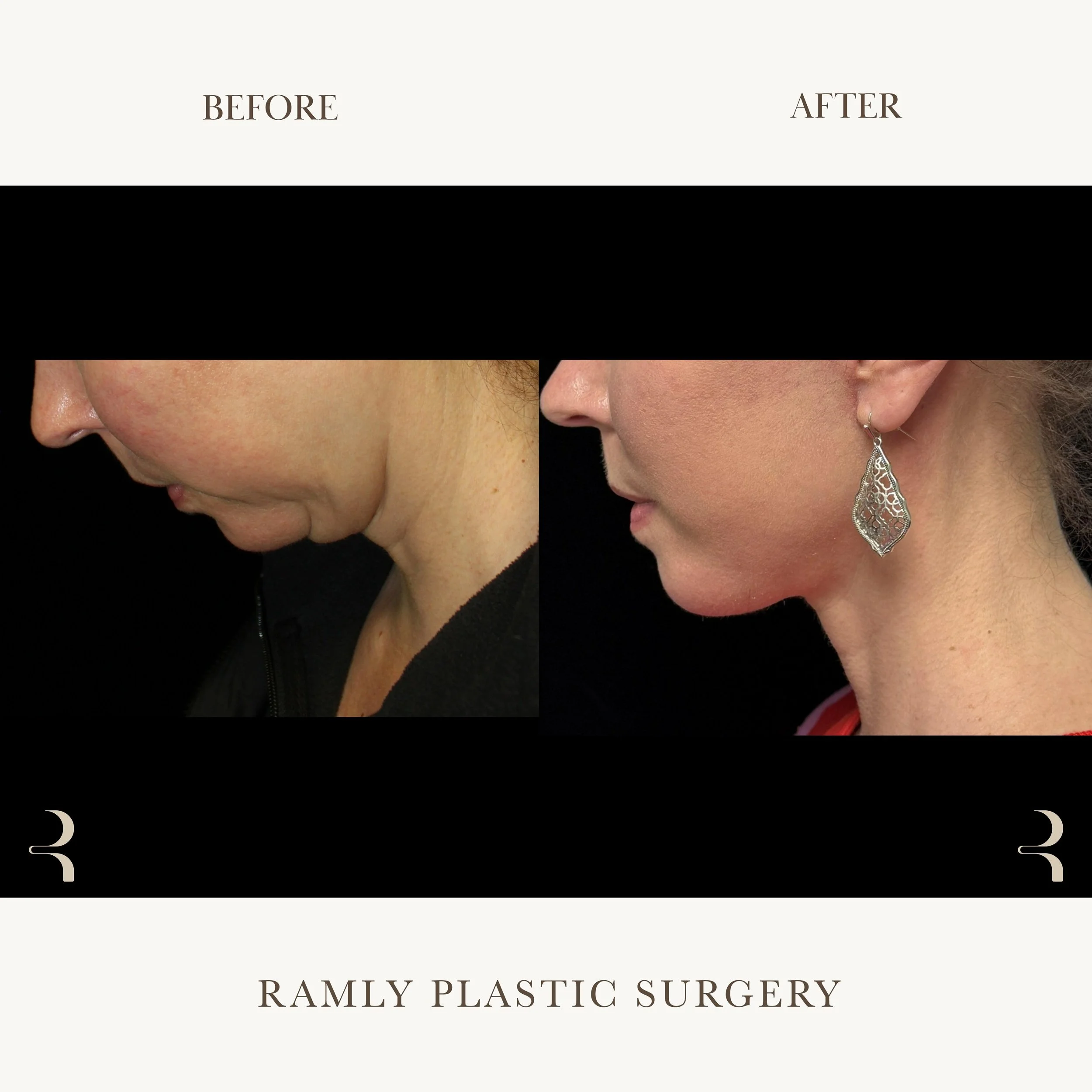
Before and after facelift and neck lift demonstrating elegant rejuvenated feminine jawline definition and neck contour maintained with motion when looking down, as well as improved midface support contributing to a natural, balanced appearance in everyday life.
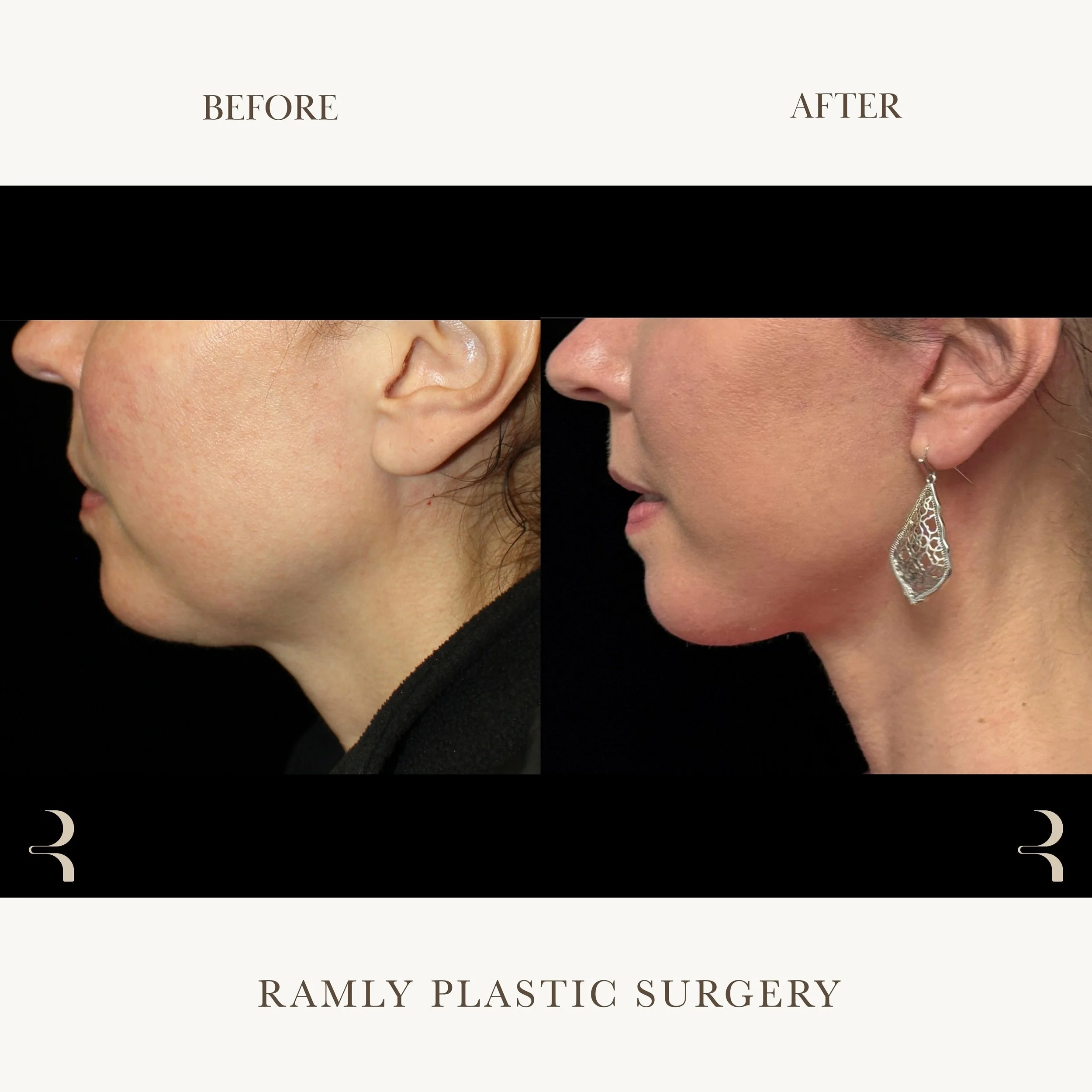
Before and after facelift and neck lift demonstrating natural feminine jawline definition, refined neck contour, and improved midface support contributing to a balanced, elegant result.
Facelift and Neck Lift Results That Hold Up in Motion
Beautiful facial rejuvenation is not simply about how someone looks in a photograph. It is about how naturally the result belongs to them in everyday life.
For this patient, a personalized facelift and deep neck lift restored a more refined, feminine jawline, improved definition beneath the chin, and created a smoother transition between the lower face and neck.
What makes this case particularly interesting is the additional before-and-after perspective photographed while looking down—an everyday position that can reveal changes in neck contour that are less apparent when the head is held upright.
The result reflects a central principle of the Ramly Method: thoughtful, anatomy-driven facial rejuvenation designed to restore youthful contours while preserving the features, expressions, and individuality that make each face unique.
Before and After: Facelift and Deep Neck Lift When Looking Down
Place the looking-down before-and-after image here, followed by the frontal before-and-after image.
These photographs demonstrate the changes achieved through a personalized facelift and deep neck lift, including improved jawline definition, reduced fullness beneath the chin, and more harmonious contours between the face and neck.
The looking-down perspective offers an additional opportunity to appreciate the improvement during neck flexion, while the frontal view demonstrates the overall balance and natural femininity of the result.
Some skin folding during neck movement is entirely normal, including in young individuals. The objective is not to eliminate natural movement or create an unnaturally rigid neck, but to improve underlying anatomical support and contour while allowing the face and neck to look and move naturally.
The Patient's Goals: Refined, Feminine, and Unmistakably Herself
This patient, a professional woman, sought a subtle yet meaningful improvement in her lower face and neck.
Her concerns included:
Early softening and loss of definition along the jawline.
Fullness beneath the chin that softened the transition between the jaw and neck.
Neck laxity and early changes in the platysma muscle.
Changes in neck definition that became particularly noticeable when looking down.
A desire for natural rejuvenation without appearing tight, pulled, or surgically altered.
She was not seeking a different face.
She wanted to preserve her characteristic facial features, feminine proportions, and natural expressions while restoring a more youthful harmony between her face and neck.
For patients seeking this kind of refinement, success is not measured by how dramatically their appearance changes. It is measured by how naturally the improvement integrates with the rest of their face.
Understanding the Anatomy: Why the Jawline and Neck Change Together
Facial and neck aging involves more than changes in the skin.
Over time, changes in skin elasticity, fat distribution, connective tissue support, and the platysma muscle can contribute to jowling, reduced jawline definition, submental fullness, and changes in the cervicomental angle—the angle between the underside of the chin and the neck.
These changes are often interconnected.
The lower face and neck share important anatomical relationships. Treating one area without accounting for the other may leave an imbalance between the jawline, chin, and neck.
In this patient, the important considerations included early lower-face descent, platysmal laxity, and submental fullness.
These findings informed the decision to combine a facelift with structural neck rejuvenation rather than focus exclusively on skin tightening or fat reduction.
The goal was to restore the natural relationship between her lower face and neck—not to impose an artificially sharp or exaggerated contour.
Why the Neck Can Look Different When Looking Down
Many facelift and neck lift before-and-after photographs are taken with the head upright or in profile.
These views are valuable, but they do not represent every position in which patients see themselves.
Looking down at a phone, reading, working at a desk, or lowering the chin naturally changes the relationship between the jawline, platysma, skin, and deeper neck tissues.
Neck flexion can accentuate submental fullness, skin redundancy, and platysmal changes.
It can also produce normal temporary folds in otherwise youthful necks.
For that reason, I believe it is valuable to assess facial rejuvenation across multiple perspectives rather than relying on a single flattering photographic angle.
In this case, the looking-down before-and-after photographs demonstrate improvement in the contour beneath the chin and the relationship between the jawline and neck during flexion.
This is especially meaningful because the patient's concerns were not limited to how her neck appeared in a carefully posed photograph.
They involved how she experienced her appearance during everyday activities.
Surgical Procedures: Personalized Facelift and Deep Neck Lift
The surgical plan was developed around the patient's individual anatomy and aesthetic priorities.
Her treatment included:
Facelift: Structural repositioning of the lower-face support tissues to improve jawline definition and soften early jowling while preserving natural facial contours.
Deep neck lift: Anatomically directed treatment of the neck to improve submental contour and the transition between the chin, jawline, and neck.
Platysmaplasty: Repositioning and repair of the platysma muscle to address muscular laxity and improve neck support.
Jawline and cervicomental angle refinement: Coordinated contour improvement designed to maintain soft, elegant, feminine proportions.
The central objective was structural rejuvenation rather than excessive skin tension.
The result was designed around her anatomy, not around achieving a predetermined surgical appearance.
The Ramly Method: Restoring Structure While Preserving Identity
My approach to facial rejuvenation begins with a detailed understanding of the individual patient's anatomy.
I do not believe that every patient needs the same facelift technique, the same degree of tissue repositioning, or the same amount of neck contouring.
The Ramly Method is my personalized framework for facial rejuvenation, built around five interconnected principles.
1. Anatomy Before Technique
The first step is identifying the actual source of the aesthetic concern.
Is jawline blunting caused primarily by descended lower-face tissues, submental fat, platysmal laxity, skin redundancy, or a combination?
Each requires a different solution.
2. Selective Structural Rejuvenation
I incorporate SMAS, deep plane, and neck-contouring techniques according to the anatomy being treated.
The objective is to reposition the appropriate structures while avoiding unnecessary dissection or excessive correction.
3. Facial Identity Preservation
The goal is not simply to look younger.
It is to look younger while retaining the features, expressions, proportions, and facial character that make each individual recognizable.
For this patient, preserving a soft, feminine jawline was just as important as improving its definition.
4. Thoughtful Timing and Surgical Restraint
Not every early sign of aging requires surgery.
Some patients benefit from observation, skin-quality treatments, or other limited interventions.
Others develop structural changes that may be more effectively addressed surgically, even when those changes are relatively subtle.
The decision depends on the patient's anatomy, priorities, medical suitability, and whether the anticipated improvement justifies undergoing surgery.
5. Personalized Recovery and Longitudinal Care
Facial rejuvenation does not end when the operation is completed.
I emphasize careful tissue handling, individualized perioperative planning, and personally involved postoperative follow-up.
Recovery strategies and supportive treatments are selected according to the patient's needs and healing progression, rather than automatically applying the same protocol to everyone.
This combination of precise planning, surgical craftsmanship, individualized recovery, and continued surgeon involvement forms the foundation of the Ramly Method.
Learn more about the Ramly Method.
When Is the Right Time for a Facelift and Neck Lift?
One of the most important decisions in facial rejuvenation is not simply which operation to perform, but whether surgery is appropriate at this particular stage of aging.
Patients sometimes believe they must wait until their jowls or neck laxity become severe before considering surgery.
That is not necessarily true.
A patient with relatively subtle but meaningful structural descent may benefit from a thoughtfully planned facelift or neck lift, particularly when the changes are bothersome and cannot be adequately corrected through less invasive measures.
However, operating too early—when the anatomical changes are minimal—may offer too little benefit to justify the procedure, its risks, recovery, and cost.
The appropriate timing is therefore highly individual.
In this case, the patient's facial anatomy and aesthetic concerns supported a focused surgical approach to the lower face and neck.
The objective was not to reverse dramatic aging, but to restore definition and balance at a stage when her individual anatomical changes warranted intervention.
The best time for facial rejuvenation is not determined by age alone. It is determined by anatomy, goals, and sound surgical judgment.
Results: Natural Feminine Jawline and Neck Rejuvenation
The before-and-after photographs demonstrate several improvements:
More continuous and refined definition along the lower face and jawline.
Reduced fullness beneath the chin.
A smoother, more harmonious transition from the chin into the neck.
Improvement in the cervicomental contour during both upright positioning and neck flexion.
Preservation of the patient's natural femininity, facial proportions, and recognizable appearance.
The frontal photograph highlights the overall harmony of the lower face and neck.
The looking-down photograph illustrates the improvement in submental contour in a position patients frequently encounter during daily life.
Importantly, the result is not defined by an unnaturally sharp angle or an excessively tightened appearance.
The objective was a youthful, elegant contour that appears to belong naturally to the patient.
Beautifully herself—with a refreshed jawline and neck that complement the rest of her face.
Facelift, Deep Neck Lift, or Neck Liposuction: Which Is Right?
Patients with concerns similar to those shown here may wonder whether they need a facelift, neck lift, neck liposuction, or a nonsurgical treatment.
The distinction depends on anatomy.
Neck liposuction can be helpful when superficial fat is the primary cause of submental fullness and skin elasticity is sufficient for the tissues to adapt after fat removal.
Platysmaplasty addresses selected problems involving the platysma muscle, including muscular laxity or banding.
Deep neck contouring addresses contributing anatomy beneath the platysma when clinically indicated.
Facelift surgery repositions the supporting tissues of the face to improve lower-face descent and jawline definition.
Combined facelift and neck lift surgery may be especially beneficial when aging affects both the jawline and neck, allowing them to be addressed as an interconnected anatomical region.
These are not interchangeable procedures, nor does every patient require all of them.
A detailed examination is essential to determine which structures are contributing to the concern and how much intervention is appropriate.
Frequently Asked Questions
Can a neck lift improve how my neck looks when I look down?
Yes. A neck lift can improve the underlying neck contour, submental fullness, and platysmal laxity that may become more noticeable when looking down.
However, normal skin folding during movement remains possible. The goal is improved anatomy and natural contour, not an immobile or completely wrinkle-free neck.
Do I need a facelift if my main concern is my neck?
Not necessarily.
Some patients benefit from an isolated neck lift, while others have accompanying jowling or lower-face descent that makes a combined facelift and neck lift more appropriate.
The decision depends on the relationship between the lower face and neck.
Is a facelift appropriate in your forties or early fifties?
It can be, depending on anatomy rather than age alone.
For selected patients with meaningful structural changes, a facelift may be appropriate even before advanced aging develops.
For others, particularly those with minimal descent or predominantly skin-quality concerns, surgery may be premature.
What is the difference between a neck lift and a deep neck lift?
A neck lift is a broad term encompassing several surgical approaches to neck rejuvenation.
A deep neck lift may include work beneath the platysma muscle to address deeper structures contributing to submental fullness and neck contour.
The exact technique depends on the individual anatomy.
Read more about deep plane neck lift surgery in Beverly Hills.
Can Botox, fillers, or skin-tightening devices replace a facelift or deep neck lift?
Nonsurgical treatments may be helpful for selected concerns, including skin quality, superficial wrinkles, or certain patterns of platysmal activity.
However, they do not reproduce the structural repositioning achieved by facelift surgery or directly correct deeper anatomical fullness in the same way as surgical neck contouring.
Treatment should be selected according to the actual source of the problem, not simply the desire to avoid surgery.
Will a facelift and neck lift make me look pulled or unnatural?
The goal of a well-planned facial rejuvenation procedure is to restore natural anatomical relationships without creating unnecessary tension or distorting distinctive facial features.
Technique selection, vector of repositioning, tissue handling, and preservation of facial proportions all influence how natural a result appears.
No operation can guarantee an undetectable outcome, but identity preservation is central to my surgical approach.
How long does it take to recover from a facelift and deep neck lift?
Recovery varies with the extent of surgery, the patient's anatomy, health, and individual healing response.
In my practice, early follow-up is closely supervised, and many patients begin to feel socially comfortable around the third postoperative week, although swelling, numbness, firmness, and continued refinement may persist for months.
Postoperative plans and recovery expectations are individualized for each patient.
How long do facelift and neck lift results last?
Structural facial rejuvenation can provide long-lasting improvement, but it does not stop the natural aging process.
Skin quality, genetics, weight changes, lifestyle, surgical technique, and individual anatomy all influence how results evolve over time.
Natural Facelift and Neck Lift Surgery in Beverly Hills
A beautifully performed facelift or neck lift should never be judged by one photographic angle alone.
It should be considered in the context of the patient's anatomy, appearance from different perspectives, facial expression, natural movement, and long-term goals.
This case illustrates how a personalized facelift and deep neck lift can restore feminine jawline definition and improve neck contour without sacrificing the individuality that makes a face beautiful.
At Ramly Plastic Surgery in Beverly Hills, my philosophy is rooted in anatomical precision, thoughtful surgical restraint, natural aesthetics, and personalized care.
The goal is never to give you someone else's face. It is to help you look beautifully, unmistakably yourself.
Elie Ramly, MD
Harvard-Trained Plastic & Reconstructive Surgeon
Beverly Hills, California
Request a private consultation
Shared with patient consent.